I wrote the first version of this to my diary on September 1st 2026; it kept occupying a part of my brain and demanded attention so I wanted to see where it goes.
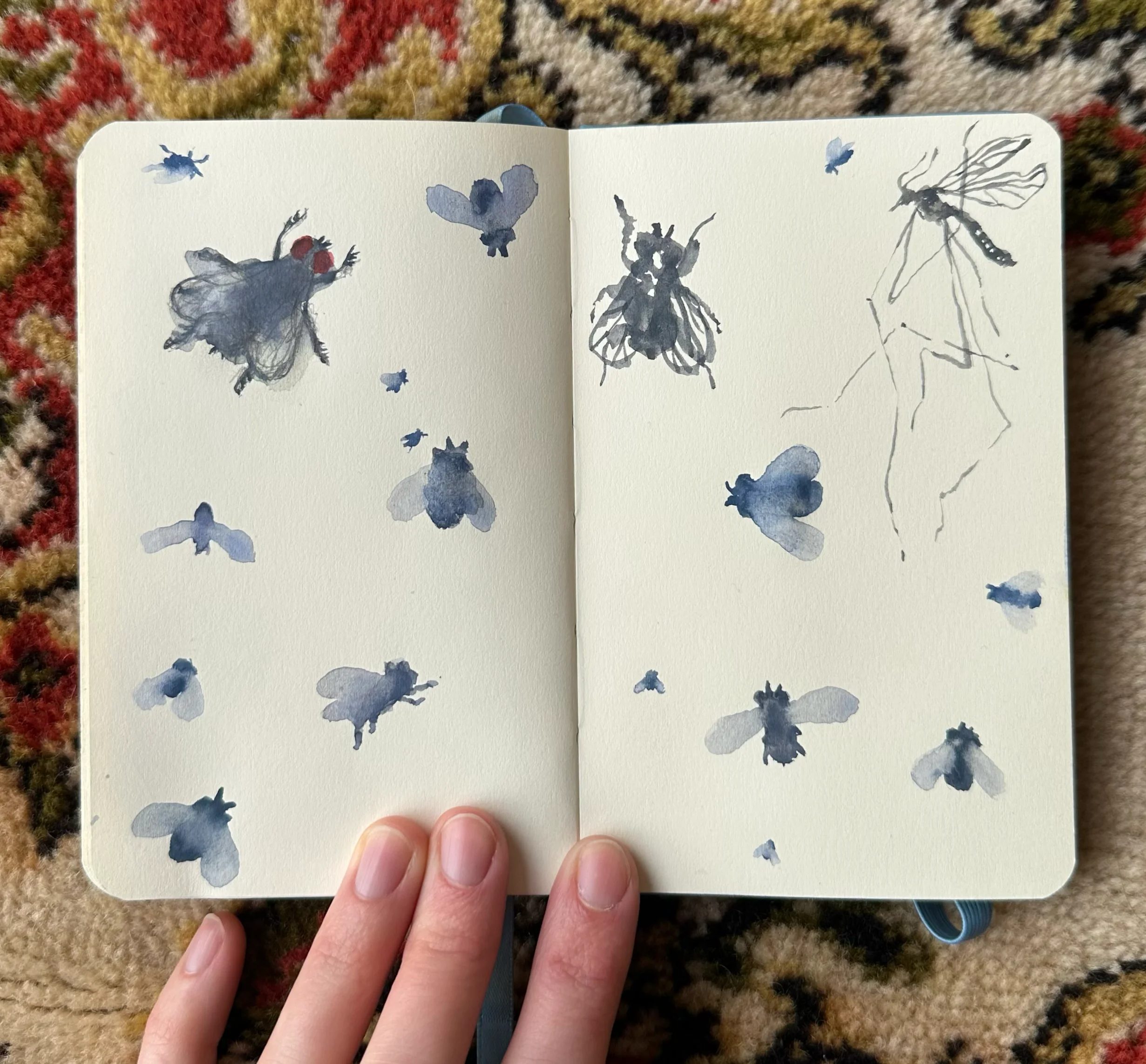
I’ve been catching flies and releasing them outside all morning. Well, I’m not really catching them, I’m holding a tea towel up with both hands and slowly guiding them out an open window. It’s surprisingly efficient. My partner just wants to do the usual swatting, but I try not to murder living beings, if there are alternatives. So, a towel and a lot of patience it is. To my surprise and annoyance, there just seems to be so many flies. Every time I think “okay finally, that was all of them, good job getting them out”, a new one appears. The other day two landed on me and started doing the deed, so perhaps it is the fruits of their shared moment of passion that are flying around the apartment now. Maybe it’s just the end of summer.
They woke me up this morning and I couldn’t fall back asleep as they were trying to fly on my face. It’s hard to describe how aggravating it is, and how difficult it makes it trying to sleep. How strenuous it is to do anything about it in the state of stupefying haziness, in that morning fog. When I finally gave up and got out of bed I was curious about their fixation for my face that seems to occur only in the morning. After a quick surf on the web (I am on a recent one-woman campaign to bring back old school internet lingo), I found out that apparently, my face offers them these things: skin oils and dead cells for food, moisture and minerals in my morning sweat, and body heat to warm them up after a chilly night. My face for them is like a little oasis in the desert. Somehow that made me feel better about myself and the whole situation, despite them cutting at least an hour of my sleep. So I remain gentle; “they just want safety, like everybody else”, I tell myself.
All of this — the flies, them mating on me, my insistence for pacifism with them — made me think about an occasion when I was a child, sitting by a river on a family holiday. I was staring at the water, enchanted by the tranquil yet powerful current, when a fly landed on my hand. I sensed it was emitting a different aura from the usual hectic timidness and constant scanning for a threat or a meal. It was on a different mission, it seemed eerily calm and determined. Then it started to lay eggs, right there on the back of my hand. A neat little cluster of white tiny ovoids. My first instinct was disgust, to swat them all away. That is what I did, and was immediately washed over by a wave of felt guilt, for what I had done. It was her little babies I just squashed. She had assessed my hand as safe enough to do the most important task it has. She trusted my hand. And I used it to shake her offspring to their death.
Freud of course famously thought that the fixations and habits we have as adults can be traced back to some event in our childhood. I’ve publicly disliked the man since my psychology undergraduate studies (a topic I have written lengthily about, but pulling out those archives is for another time). Nevertheless, he would say that I clearly still carry some fly baby murderer guilt that makes me choose non-violence towards them as an adult. Maybe he’s right. Or maybe I just don’t like the idea of killing a another creature. Whether it derives from childhood trauma or not, I think it’s a pretty good philosophy to not kill innocent beings. To not feel like you’re above another life form. Of course that’s not completely realistic — If I would have to choose between a fly and a human or a dog or even a lizard, it’d be goodbye for the fly. But if I can choose between killing and not killing, I go for the latter. Even if they keep me awake or lay eggs on me.
Weirdly enough, I don’t remember if that was how the moment actually went. There is another version of the story in my mind that feels equally vivid and true. In that version I gently observe the eggs, tell the mother she did a good job and find the eggs a safe place. This is the version I think I constructed later on, a version of how I would have liked things to go. It feels like if I really wanted to lean into that story instead, I could convince myself that it’s true. Multiple cognitive psychologists have arrived to the conclusion that we constantly reconstruct memories (Loftus) to fit our current worldview and schemas (Bartlett) or to fit the story that we tell to ourselves about what kind of person we are (Conway).
I like to be seen as a person who doesn’t kill innocent beings, even if they’re ‘just bugs’. I take pride in loving nature and all the creatures in it. I cohabit with spiders. I notice the songs of birds, I observe even the city rats with deep fascination. I lift stones in the hopes of rolypolies, I love spotting colourful caterpillars munching on leaves. Once I cried when my friend squashed an ant (two days prior to getting my periods so that might have played a role). At the same time, I’ve got a fruit fly trap set up in our kitchen, and it only makes me remotely guilty. I whisper my apologies to them while pouring their tiny dead bodies down the drain.
We have to be faced with the complexity of our being all the time; there will always be occasions where our views and actions are in conflict*. The human experience is strange; we navigate the world with a high functioning brain with a lot of capacity, yet it cannot take in and process everything it sees thoroughly. As it’s trying to make sense of the world, it makes constant logical and emotional shortcuts by cramming information into existing narratives and categories, manipulating and ignoring information if it doesn’t fit in with already existing schemas. A lot of this is done in a way that one is not aware of, unless practicing a conscious breaking-apart of one’s thoughts, actions, and reactions. Which is where Jung and shadow work enters the picture.
The Jungian shadow is the parts of yourself you have repressed and hidden away for various reasons. Often emotions and characteristics perceived as negative such as shame, jealousy, and anger, but also for example creative potential or instincts. It’s not evil; it is just one’s characteristics that were often unwanted by the social environment or were perceived as ‘too much’ or ‘too weird’, and repressing them felt beneficial for social integration. In shadow work, you are not trying to get rid of your ‘unwanted’ characteristics, but to recognise them and bring them into your conscious awareness. That way you can interrogate them and not let them come out impulsively and as projections put onto others.
I’m a hypocrite in many aspects, and so are you. Being a hypocrite is a default, we can only get better at recognizing these conflicts and where they might stem from. I value the life of a fly and avoid killing them, yet if I do kill one I won’t dwell on it very long. Who knows what other inconsistencies I hold without even knowing — but it is important to try to find out so we can begin to question them.
*Largely, but not only, due to having to live in a society that doesn’t match with our values. The cognitive dissonance for having to directly and indirectly participate in horrendous acts of systemic exploitation is abnormal and out of proportion. Even though I argue that the cognitive dissonance would always be there in some scale in any scenario, this argument is not justifying an abusive system and the act of ignoring exploitation that is happening as ‘a normal state of things’.
~A disclaimer that none of this text has been touched by AI at any point, it’s the product of my very own human brain and research done by other human brains.~